Kuki Apex Body Lays Charter of Demands Before PM; Appeal For Peace as Community Enters Two-Day Nationwide Mourning Amid Outrage and Grief
KIM said the Kuki community must not be drawn into a cycle of violence that would only benefit forces seeking to divide and destabilise tribal communities.
By Kaybie Chongloi — On May 14, 2026
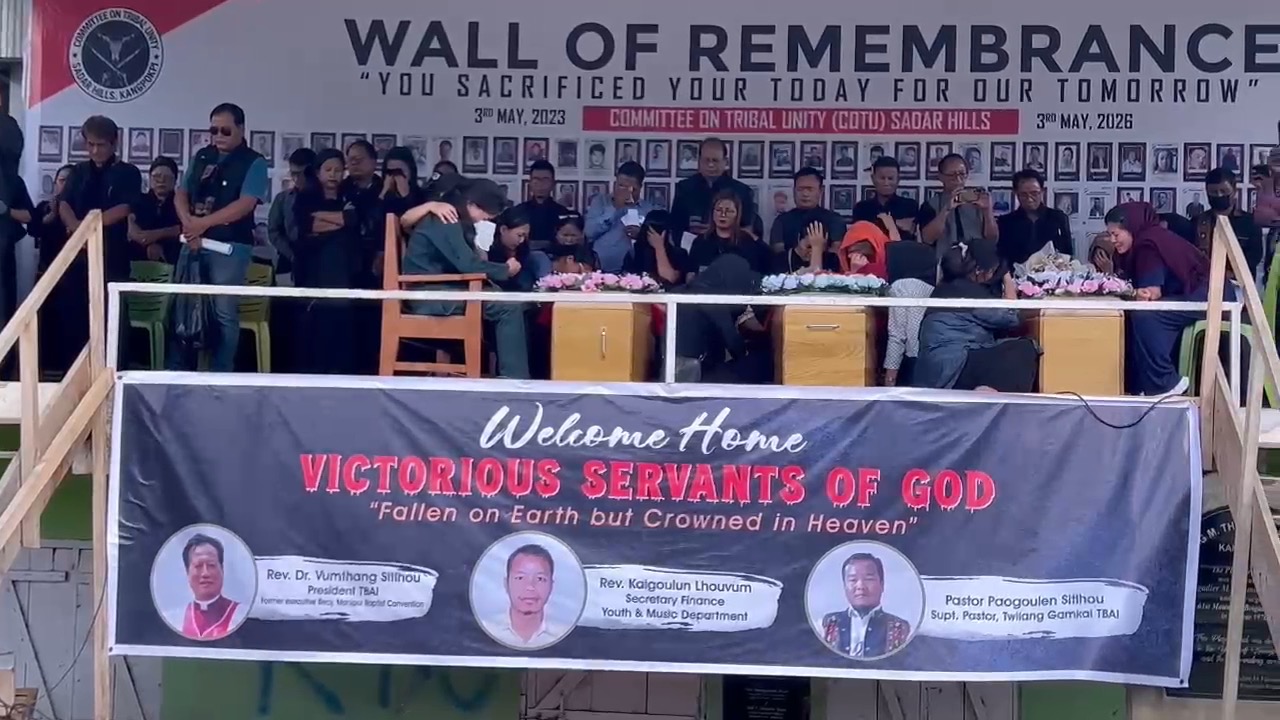
In an extraordinary outpouring of grief, defiance and collective resolve, thousands of Kuki-Zo people from across Sadar Hills on Thursday converged at Brig. M. Thomas Ground in Kangpokpi district headquarters to mourn the brutal killing of three prominent Church leaders whose deaths in a deadly ambush on the Kangpokpi–Churachandpur road have plunged the community into one of its darkest chapters.
As the Kuki-Zo community formally entered the first day of a two-day nationwide mourning declared by Kuki Inpi Manipur (KIM), the apex body of the Kuki tribes simultaneously escalated its response beyond mourning by formally laying a charter of demands before Prime Minister Narendra Modi through the Deputy Commissioner of Kangpokpi, seeking urgent intervention, justice, and decisive protection for the embattled community.
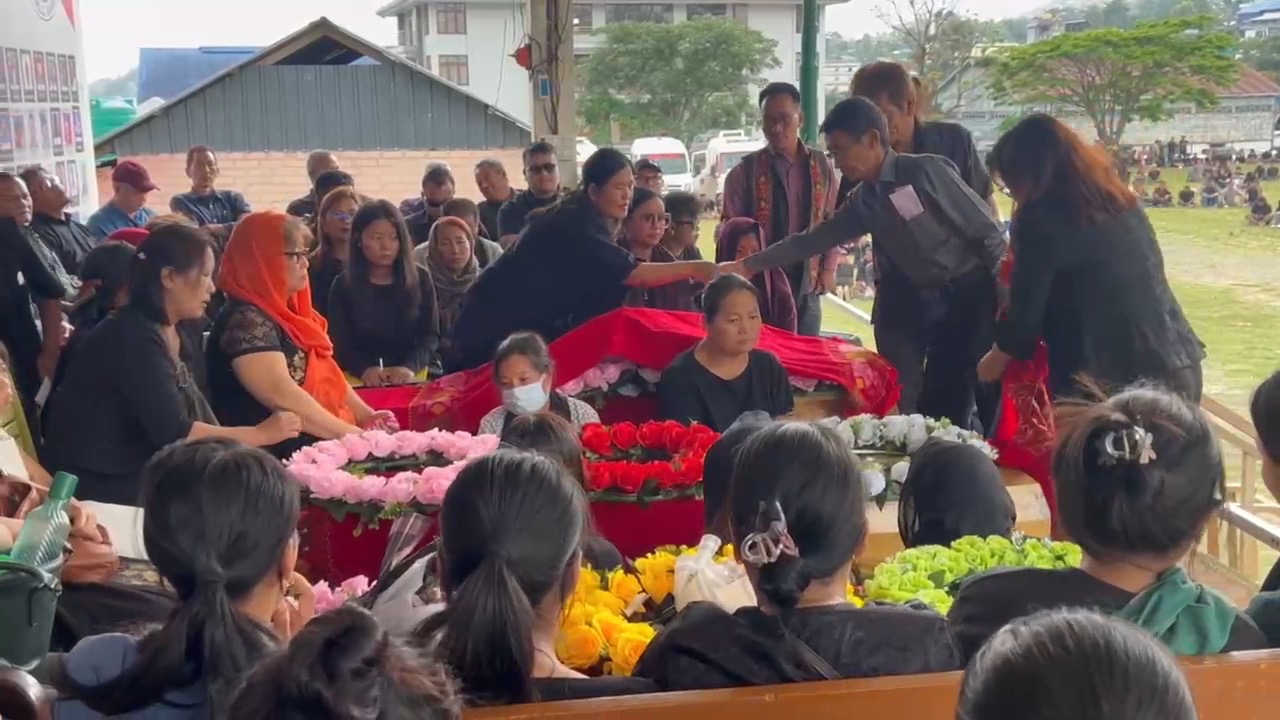
The district headquarters transformed into a sea of mourning as the mortal remains of Rev. Dr. V. Sitlhou, Rev. Kaigoulen Lhouvum and Pastor Paogoulen Sitlhou — slain in the fatal May 13 ambush — were brought from the District Hospital following post-mortem examinations. Scenes of heartbreak unfolded as grieving families, church members, tribal leaders, women’s groups, students, chiefs, and civil society organisations received the bodies with tears, prayers and solemn tributes.
Under the aegis of Kuki Inpi Manipur, with the Committee on Tribal Unity (CoTU) leading the day-long condolence programme, Brig. M. Thomas Ground became the epicentre of a historic public mourning where grief was fused with a powerful political and humanitarian message.
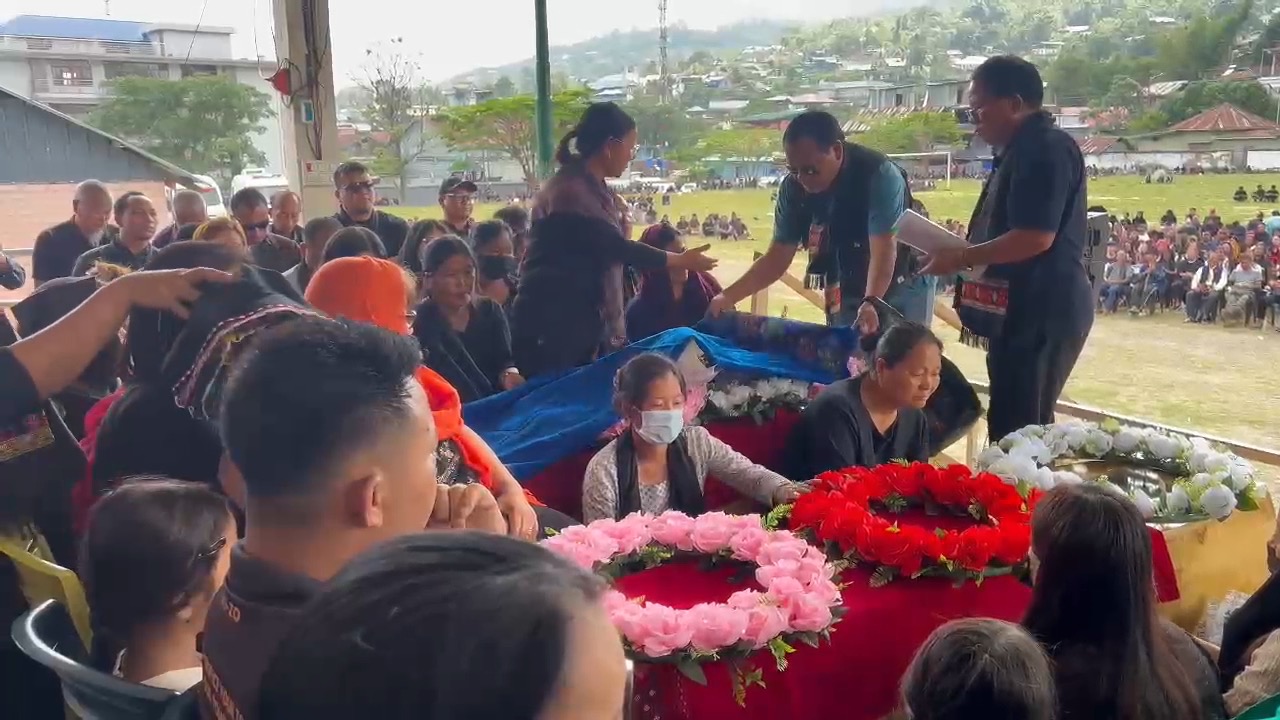
In deeply emotional ceremonies, Kuki Inpi Manipur President Ch. Ajang Khongsai, Thadou Inpi General Headquarters President Chongpu Kipgen, Sadar Hills Chiefs’ Association President Haokholen Kipgen, representatives of the Kuki-Zo Council, Kuki-Zo Christian Forum Secretary Dr. Satkai Chongloi, alongside other prominent leaders, paid their highest tribute by ceremonially wrapping traditional shawls around each coffin — a profound symbol of honour, sacrifice and communal reverence.
The tributes continued as leaders from various Tribe Inpis, Kuki Women Union, human rights organisations, student bodies, church institutions and numerous Kuki-Zo civil society organisations stepped forward one after another to offer shawls and final respects, transforming the ground into a living testimony of unity in loss.
Speaker after speaker described the slain Church leaders not merely as victims, but as martyrs whose blood, they said, had become a sacred offering for peace, justice and the survival of the Kuki-Zo people amid escalating violence.
Rev. Thangsat Kipgen who attended as the Minister prayed for the departed noble souls to rest in peace in the hands of the Lord.
Later, after the condolence program, the mortal remains of the three Church leaders were taken to their respective home for a night condolence and mourning.
Tomorrow, the mortal remains ofthe three Church leaders will be taken at TBA-I Church Campus at Motbung for the burial ceremony.
Against the emotionally charged mourning service, Kuki Inpi Manipur submitted a memorandum to the Prime Minister, placing before the nation’s highest office what leaders called the urgent voice of a grieving but resolute people.
Calling the killings a direct assault on peace, faith, and the survival of the Kuki-Zo people, KIM said in the memorandum that the deliberate targeting of church leaders and peace emissaries has “deeply shaken the confidence” of the community and exposed “grave security vulnerabilities” in the conflict-ridden hill districts.
The Charter of Demands includes:
• Immediate high-level NIA probe into the ambush and prosecution of all perpetrators and conspirators.
• Permanent security guarantees for Kuki-Zo civilians, church leaders, civil society members, and vulnerable villages.
• Establishment of special security zones in conflict-prone areas to prevent further attacks and blockades.
• Official recognition by the Government of India of the repeated persecution and victimisation of the Kuki-Zo people.
• Expedited political engagement with Suspension of Operations (SoO) groups to address what it termed the “root causes of insecurity and ethnic persecution.”
The Kuki Apex body also announced that the Kuki-Zo people would continue observing mourning days (Sahnit) until justice is delivered and their demands are meaningfully addressed.
Meanwhile, the Kuki Inpi Manipur also issued a strong appeal for peace, warning against any escalation into a violent Kuki-Naga confrontation and asserting that “enough blood has been shed.”
KIM said the Kuki community must not be drawn into a cycle of violence that would only benefit forces seeking to divide and destabilise tribal communities.
“At this critical juncture, as we stand on the brink of a potentially violent conflict, enough blood has been shed. It must stop now,” KIM statement said.
Making it clear that the Kuki people do not seek confrontation with fellow tribal communities, KIM stressed that not all Tangkhuls or Zeliangrong communities support conflict. It noted that many civil society organisations across communities remain committed to peace and coexistence.
However, the organisation expressed serious concern over what it described as a disturbing pattern of provocation and mobilisation by certain groups, including ZUF (Kamson), FNCC, TNFO, and Khanuithot Khon, alleging that their actions have significantly eroded trust and harmony among tribal communities.
According to KIM, such developments are pushing communities toward an “unnecessary and avoidable conflict” at a time when restraint is critical.
The apex body urged all stakeholders — community leaders, civil society organisations, and government authorities — to act responsibly, de-escalate tensions immediately, and engage in meaningful dialogue.
Reiterating its firm commitment to peace, dialogue, and coexistence, Kuki Inpi Manipur called on all sections to reject attempts to incite division or violence and to work collectively toward preserving unity and stability among tribal communities.
Across Kuki-Zo inhabited regions, the 48-hour shutdown remained total, with roads empty, businesses shuttered and public life suspended, while black flags, prayer meetings and candlelight vigils underscored the scale of anguish.
A non-profit citizens watchdog of the media which believes in "public enlightenment" as the forerunner of justice and the foundation of democratic principles.