
Selective Statistics and the Need for a Comprehensive Understanding of Manipur's Demographic Transformation
N Biren Singh is now all out to fuel enmity between two hill communities, pitting one against another.
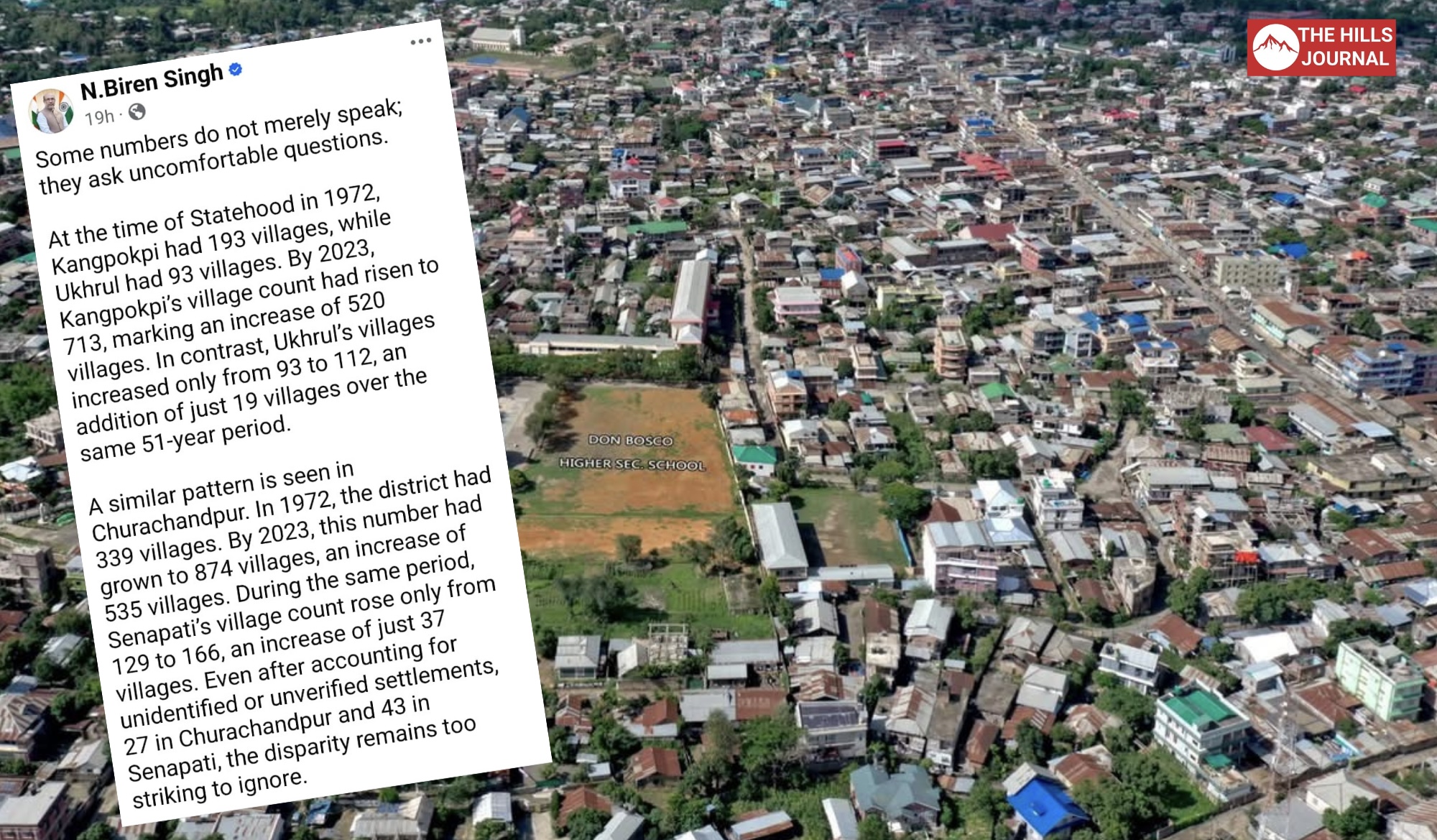
Mr. N. Biren Singh, who served as Chief Minister of Manipur during the period leading up to and throughout the outbreak of the ethnic conflict of May 2023, continues to seek relevance in the State's political discourse through frequent public statements and social media interventions. Despite no longer holding public office, he remains actively engaged in shaping narratives around the conflict and inter-community relations. His recent effort to frame demographic questions through a comparison of Kuki-Zo-majority and Naga-majority districts is only revealing.
The political narratives promoted during his tenure contributed significantly to the deterioration of relations between the Kuki-Zo and Meitei communities and helped deepen the divisions that ultimately culminated in the violence of May 2023. He has not stopped there. N Biren Singh is now all out to fuel enmity between two hill communities, pitting one against another.
The case in point is, his selective focus on demographic comparisons between Kuki-Zo-majority and Naga-majority districts which raised concerns that similar narratives may further strain relations between communities and deepen the already complex ties.
Recent social media interventions by Mr. N. Biren Singh have sought to draw attention to the growth in the number of villages in the Kuki-Zo-majority districts of Churachandpur and Kangpokpi by comparing them with the Naga-majority districts of Ukhrul and Senapati. While such observations may appear to raise legitimate questions concerning settlement patterns and administrative expansion, they simultaneously invite a more fundamental methodological question: Why are only these four districts selected for comparison ?
Any meaningful analysis of demographic change and settlement dynamics must be grounded in a comprehensive, state-wide framework rather than a selective examination of particular districts. The exclusion of the Imphal Valley districts from the discussion is particularly significant, given the extensive demographic, spatial and developmental transformations that have occurred in these regions over the same period. Consequently, the analytical value of such comparisons remains limited unless situated within the broader context of Manipur's overall demographic and geographical evolution.
The selective comparison of Kuki-Zo-majority and Naga-majority districts risks generating interpretations that portray specific regions as demographic anomalies while overlooking comparable processes elsewhere in the State. From a lay perspective, demographic analysis requires consistency in the selection of variables, geographical units and historical timeframes. Isolated statistics, when detached from broader contextual factors, may lead to conclusions that are incomplete or potentially misleading.
Understanding village growth in Manipur requires recognition of the distinct historical trajectories and socio-cultural institutions of different communities. The Kuki-Zo, Naga and Meitei communities have historically developed different worldviews, settlement systems, land tenure arrangements and village administrative structures. Consequently, changes in the number of villages cannot be interpreted solely through numerical comparisons. Rather, they must be examined in relation to historical settlement practices, customary land management institutions, administrative reorganisation and patterns of population distribution.
If concerns are being raised regarding the increase in the number of villages, then population growth trends should also form part of the analytical framework. Census data indicate that between 2001 and 2011, the population growth rates in Mao-Maram, Paomata and Purul Sub-Divisions of Senapati District (Naga dominated district) were approximately 143 %, 123 % and 169 % respectively. These figures underscore the importance of examining demographic change through multiple indicators rather than relying exclusively on village counts as a measure of transformation.
Notably, these ‘abnormal’ population growth received considerable public and scholarly attention during the 2000s. Questions regarding the drivers of such demographic changes were widely debated in public discourse and policy circles. Yet, contemporary discussions appear to focus disproportionately on village proliferation while paying comparatively little or no attention to population dynamics. The reasons for this shift in public attention merit careful examination, particularly when demographic change is invoked as a basis for political argument.
Now let us talk about the Imphal Valley.
Equally relevant is the long-term geographical transformation of the Imphal Valley. Several areas that presently constitute major residential, commercial and institutional centres were historically wetlands and water bodies. This historical reality is reflected in place names such as Keishampat, Lamphelpat, Porompat and Heingangpat, etc where the suffix ‘pat’ denotes lakes or wetlands. Over several decades, processes of land reclamation, urban expansion, infrastructure development and commercial growth have significantly altered the physical landscape of the Valley.
From a land-use perspective, these developments represent substantial transformations comparable in significance to settlement expansion in the hill districts. Therefore, if village proliferation in the hills is considered a legitimate subject of inquiry, then wetland reclamation, urban growth and land-use change in the Valley should likewise be examined within the same analytical framework. Applying different standards of scrutiny to different regions undermines the objectivity of the inquiry.
A number of pertinent questions therefore arise. When the village numbers cited for Kangpokpi and Churachandpur were recorded in the early 1970s, what was the extent of settlement in areas such as Keishampat, Lamphelpat, Porompat and Heingangpat? How much residential, commercial, educational and governmental infrastructure has subsequently been established on lands that were once wetlands or water bodies? What has been the scale of demographic, environmental and spatial transformation in these areas over the same period? Such questions are essential for constructing a balanced understanding of Manipur's development trajectory.
The broader issue extends beyond the growth of villages in any particular district. It concerns the need for a rigorous and comprehensive assessment of demographic change, migration, settlement patterns, urbanisation, environmental transformation and land-use practices across the entire state. Sustainable peace and informed policymaking require evidence-based analysis that is methodologically consistent and geographically inclusive.
Ultimately, public discourse on demographic change in Manipur should be guided by comprehensive evidence rather than selective statistical comparisons. A complete understanding of the state's evolving demographic and geographical landscape can emerge only when all regions, communities and developmental processes are subjected to the same standards of inquiry and analysis. Such an approach is indispensable not only for scholarly accuracy but also for fostering informed dialogue, mutual understanding and long-term social cohesion.
No wonder, the divisive narratives propagated during his tenure contributed significantly to the deterioration of relations between communities and helped create an atmosphere of mistrust and hostility. It is therefore concerning that, at a time when Manipur desperately needs reconciliation and healing, Mr. Biren Singh continues to make interventions that appear to single out particular communities for scrutiny.
Selective statistics cannot explain Manipur's complex reality, Mr N Biren Singh. You can only convince that group of people who Mr. Chongtham Bijoy called ‘Heingang Troll Party.’
(Views expressed are personal)


The Hills Journal
K. Salbung, Churachandpur
Manipur-795128