
MCSCCE 2022: Examining Fairness in Extraordinary Times
The Commission conducts the Manipur Civil Services Combined Competitive Examination (MCSCCE), widely regarded as one of the most prestigious gateways to public service in the State.
Introduction
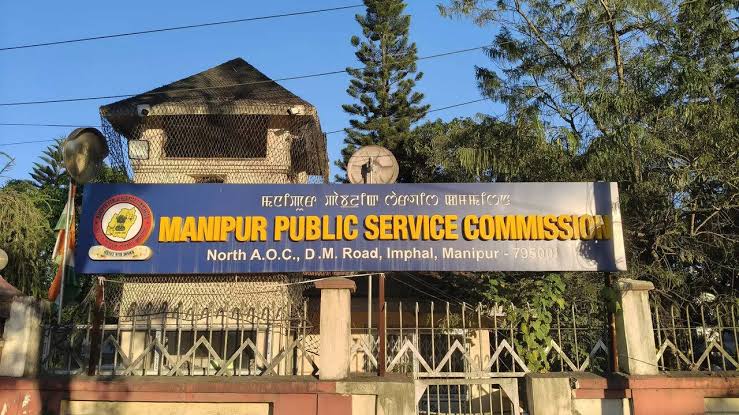
The Manipur Public Service Commission (MPSC) was officially constituted on October 26, 1972 under Article 318of the Constitution of India. The Commission conducts the Manipur Civil Services Combined Competitive Examination (MCSCCE), widely regarded as one of the most prestigious gateways to public service in the State. Its legitimacy rests not merely on being a constitutional body but on a collective belief that every candidate, irrespective of ethnicity, geography, or political circumstance, competes on a level playing field for the coveted positions such as MCS, MPS, MFS, SDC, etc. It is precisely from this standpoint that the MCSCCE 2022 results, declared on 22nd April 2026, after a prolonged three-year examination process disrupted by the ongoing ethnic conflict in the State, warrant deeper analysis.
Heart-warming stories of success flooded social media, particularly from the Imphal valley. While I share the joy of the successful candidates, I cannot ignore certain concerns that emerged from the examination process. For many within the Kuki community, the MCSCCE 2022 was not simply another competitive examination. It was a test conducted amidst one of the darkest periods in Manipur's contemporary history, during which the state has remained physically, psychologically, and administratively divided since 3rd May 2023. In such a context, the critical question is not merely who succeeded and who failed, but whether all candidates were afforded an equal opportunity to compete. It is this concern that gives raise to broader questions regarding fairness, equal opportunity, and public confidence in the recruitment process. After all, MPSC as a constitutional body, is expected to serve all citizens equally and not any particular community or group.
Competition Amid Conflict: Structural Disadvantage
Success in a highly competitive exams like MCSCCE depends not only on intellectual preparation but also on psychological readiness, access to resources, coaching opportunities, mock interviews, and most importantly a peaceful and stable environment. Unlike many Meitei and Naga candidates, numerous Kuki candidates found themselves totally cut off from the State's administrative and educational hub. Amid widespread displacement, they were compelled to prepare under conditions marked by insecurity, trauma, psychological stress, limited access to resources, and profound uncertainty. What added to their woes was that several candidates were internally displaced persons (IDPs) whose homes had been destroyed or abandoned, livelihoods disrupted, and educational pursuits severely interrupted by the conflict.
The conflict also transformed what was once a routine journey into a costly and precarious undertaking. Candidates from Churachandpur, Kangpokpi and other Kuki-inhabited districts had to travel through Mizoram or Nagaland—onward to Guwahati, spending thousands of rupees and enduring significant logistical challenges to attend the personality test(PT) after a hard-fought written (mains) examination also under perilous circumstances. Under such exigencies the Kuki candidates had to compete and perform against those enjoying relative stability. What was and should have been a mundaneexamination process took a toll on them.
Against this backdrop, one cannot disregard the profoundinfluence of lived-experiences and socio-environmental realities shaped by conflict on an individual’s ability to perform. The arduous condition these candidates had to endure had placed them at a clear disadvantage. These circumstances were not of their making, yet the measures taken to address their unique challenges appeared limited and inadequate.
Selection and Public Confidence
Whether or not the examination was intentionally discriminatory is difficult to establish. However, it is undeniable that Kuki candidates entered the competition burdened by disadvantages that many others candidate from the Meitei and Naga candidate did not face—at least in the quantum of measures. It is through this lens that the present article seeks to draw public attention by revisiting the previous examination conducted by the commission through the narrow prism of ST reservation.
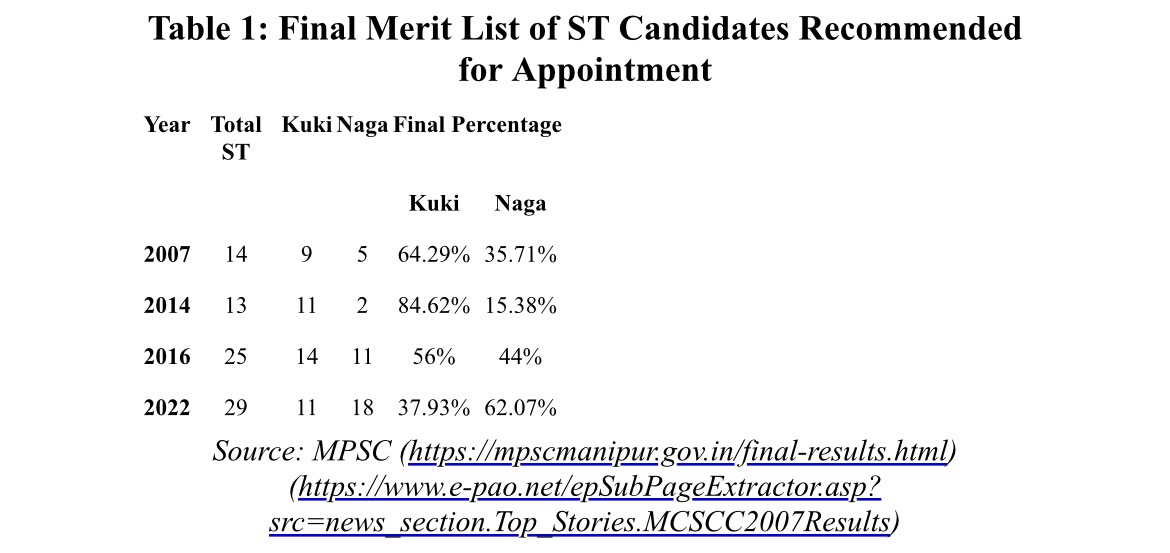
A comparative analysis of the previous MCSCCEexaminations (Table 1) revealed that Kuki candidates were well ahead of their hill Naga counterpart, particularly within the ST category occupying a substantial proportion of top positions among ST candidates. Kuki candidates, account for 64.29 per cent in 2007 and peaking at 84.62 per cent in 2014—experienced a steady decline in proportional representation, reaching 37.93 per cent in 2022. Conversely, Naga candidates increased their share from abysmal 15.38 per cent in 2014 to 62.07 per cent in 2022, becoming the majority within the ST category for the first time. This invariably raised eyebrows as it coincides with the ongoing conflict.
The argument, however, is not to dismiss the possibility of the present outcome; rather, it only seeks to extend the benefit of the doubt, given the timing and the circumstances under which the examination was conducted. Consequently, questions regarding fairness and equity upon the State and MPSC are both legitimate and reasonable, as its mandate is to uphold these principles and ensure accountability in the conduct of such an important exam.
Equal Opportunity but an Unequal Burden
Of the three stages of the exam—Preliminary, Main, and PT—it was the PT stage that raises the most profound questions. Unlike written examinations, PT involve an element of subjective assessment. Public confidence in such processes depends heavily on the perceived neutrality and representativeness of the interview board. In a deeply polarised environment, perceptions matter almost as much as realities. Many Kuki candidates expressed grave concern regarding the composition of interview boards, particularly and the absence of Kuki representation and the perceived exclusion of a number of otherwise deserving candidates from the final selection.
Perhaps what contributed to this concern was the absence of meaningful institutional accommodation for Kuki candidates affected by the conflict. With the capital city Imphal effectively inaccessible, Kuki candidates were compelled to navigate the challenges of appearing for the PT in Guwahati, hundreds of kilometres away, largely on their own and often dependent on the assistance and hospitality of others. Such impediments were not experienced to the same extent by many candidates from the other communities. Furthermore, reports of requests made by candidates for support mechanism, including access to government accommodation in Guwahati for the PT was being overlooked. This have reinforced the perceptions of institutional indifference and diminished confidence in the Commission among sections of the affected community.
Even if such decisions were driven by administrative constraints rather than discriminatory intent, many candidates perceived that they had been left to navigate extraordinary challenges largely on their own, without any consideration towards their circumstances. While the effort of MPSC may be applauded for facilitating alternative centres for the PT during such an unprecedented time, its silence on the concerns raised by candidates cannot be justified.
This then raises a deeper question: can the MPSC continue to command public trust as the agency responsible forconducting the State’s premier recruitment, while Manipur remains in a state of protracted conflict and deep social divide? This is a legitimate question the commission cannot shy away from because from 2007 MPSC (Manipur) has conducted MCSCCE only four (4) times—compared to Mizoram twelve (12) times since 2013. Such a contrast invites reflection on the institutional credibility and resilience of recruitment systems operating under vastly different socio-political realities.
Conclusion
For many Kuki aspirants, MCSCCE 2022 may indeed be remembered as a decisive defeat—not necessarily because they lacked merit, but because they were compelled to compete while carrying burdens that no examination was designed to account for. The challenge before Manipur is therefore larger than recruiting civil servants. It is about rebuilding faith in public institutions. Unless every stakeholder believes that it has an equal stake in the system, meritocracy will remain contested and legitimacy tainted with scepticism. In addition, Manipur urgently needs peace, stability, and the political commitment to institutionalise a civil service recruitment process that is regular, credible, transparent, people-centric, and free from bias and corruption.Hence, until a durable political settlement is reached, conducting the MCSCCE under the supervision of a neutral external agency such as the Union Public Service Commission (UPSC) may merit consideration. While such a proposal may face constitutional and administrative challenges, it underscores the need to preserve public trust in the integrity, fairness, and credibility of the State’s premier recruitment process, because MCSCCE isn’t merely a coveted exam, butthe pivot that legitimately shapes the present and future discourse of a community for years to come.
(Views expressed are personal)
The author is a Doctoral Scholar (PhD.), from NIEPA, New Delhi. He hails from Saihenjang Village in Churachandpur district.


The Hills Journal
K. Salbung, Churachandpur
Manipur-795128