
When Education Becomes Another Casualty: The Plight of Kuki-Zo Students in Northern Kangpokpi
This is not merely an administrative issue. It is an educational crisis.
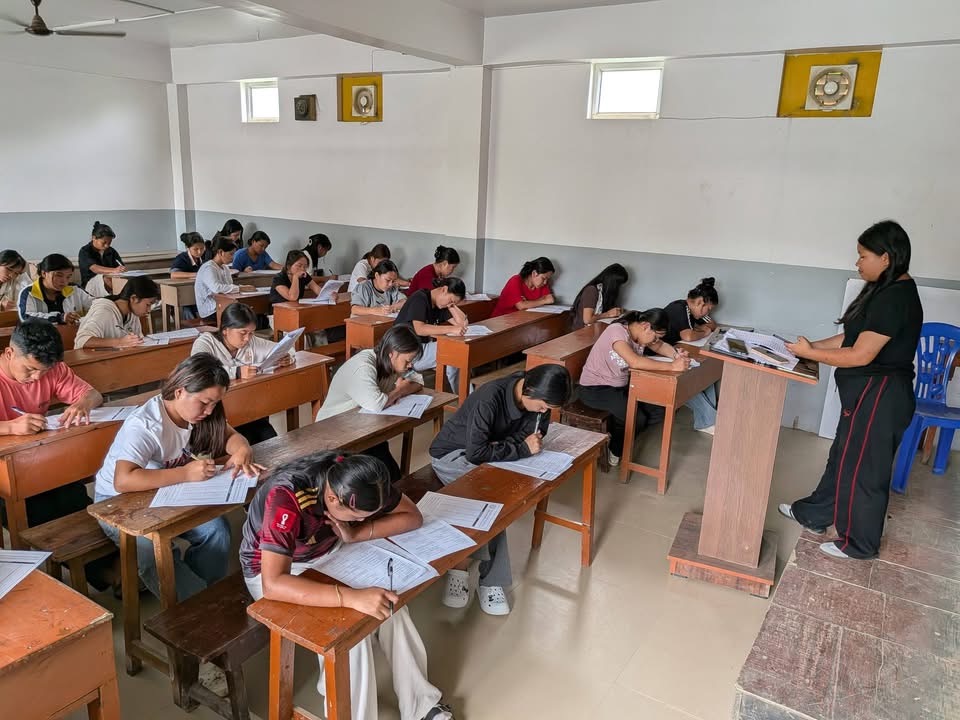
Can we honestly speak of equal opportunity if students cannot safely reach the place where opportunity begins?
For most students in India, preparing for an SSC or banking examination is a test of perseverance, discipline and hard work. For Kuki-Zo students from northern Kangpokpi district in Manipur, however, another test comes first: whether they can safely reach the examination centre.
Education should never become a casualty of conflict. Yet for hundreds of Kuki-Zo, the pursuit of government employment has become increasingly uncertain, not because of a lack of preparation or determination but because of circumstances beyond their control.
Unlike several other districts in Manipur, northern Kangpokpi has no examination centre for major competitive examinations such as SSC and banking recruitment. For years, aspirants have been compelled to travel long distances simply to sit for examinations. Today, amid renewed violence and insecurity, what was once an inconvenience has become a serious question of safety.
Recently, Deputy CM Nemcha Kipgen reportedly appealed to the SSC Chairman, S Gopalakrishnan, highlighting the travel hardships and security concerns faced by students while requesting that an examination centre be established closer to the affected region. However, the request did not result in the creation of a new centre, leaving many aspirants with few practical options.
This is not merely an administrative issue. It is an educational crisis.
The region continues to struggle with economic hardship, inflated prices, disrupted transport and prolonged uncertainty. Several villages have been affected by violence and normal life has been repeatedly interrupted. Under such conditions, expecting students to undertake four or five hours of travel through insecure routes simply to write an examination raises a fundamental question: can equal opportunity truly exist when safety itself is uncertain?
The concern is not hypothetical. The recent deterioration of peace in northern Manipur, following the reported ambush that killed three Thadou pastors and subsequent incidents of violence by ZUF Kamson group, proxy link to NSCN IM, has further heightened fear among residents. The kidnapping of 14 Kuki-Zo daily wage earners and the burning of villages have deepened the sense of insecurity. Whether or not every incident has resulted in legal action remains a matter for the authorities but the fear experienced by ordinary students is undeniable.
How can a student be expected to focus on an examination when the journey itself is filled with anxiety?
Since the outbreak of the 2023 Meitei-Kuki conflict, many Kuki-Zo candidates from the region have relied on Kohima as their nearest accessible examination centre. The present security situation has complicated even that option. Students are now caught between two impossible choices: risk their safety or miss opportunities that may determine their future.
This raises difficult but necessary questions.
Where are the student organisations that have long championed the rights of students? What practical steps are being taken to ensure that education remains accessible during times of crisis? What does the constitutional promise of equal educational opportunity mean when students cannot safely reach an examination hall?
The government cannot afford to overlook these concerns. Access to competitive examinations is not a privilege; it is an essential pathway to employment and social mobility. Denying safe access, whether intentionally or through administrative inaction, disproportionately affects students who are already burdened by conflict.
Equally concerning is the way public narratives surrounding the Kuki-Zo community are sometimes shaped. During periods of conflict, media reporting carries immense responsibility. Commentary that presents allegations without sufficient verification risks reinforcing prejudice and damaging the reputation of entire communities.
For example, the claims of Mr Lungleng in one of his Facebook page, citing the Indian security forces have uniformly favoured the Kuki-Zo community over another should be examined carefully and supported by credible evidence before being presented as fact. The constitutional duty of India's security forces is to protect all citizens irrespective of ethnicity or community.
Providing protection to civilians facing immediate danger should not automatically be interpreted as political alignment with any particular group. Every Indian citizen deserves security and humanitarian assistance when confronted with violence. Kuki-zo peoples, already living through violence and existential crisis should not bear the burden of misinformation over and over.
In fact, the Kuki-Zo people, like every other community, have contributed to the nation in numerous ways, including service in the armed forces and other public institutions. Their rights as citizens should never be questioned because they receive protection during times of crisis.
At its heart, this issue is not about politics. It is about students who wish to compete on equal terms with their peers across the country. They ask not for special treatment but for a fair opportunity to sit for examinations without fearing for their lives.
Conflict should not determine a student's future. Education must remain a bridge toward peace, opportunity and hope, not another victim of violence.


The Hills Journal
K. Salbung, Churachandpur
Manipur-795128