Barely a day after the arson attack on Kailenjang Kuki village in Manipur’s Kangpokpi district, unidentified miscreants allegedly torched at least nine houses at Tokpa Naga village in the district, triggering fresh tension and a sharp confrontation between security forces and Kuki-Zo women over what they termed “selective” security operations.
The Tokpa Naga village was attacked at around 9.30 pm on Tuesday, with at least nine houses reportedly set ablaze, according to local sources.
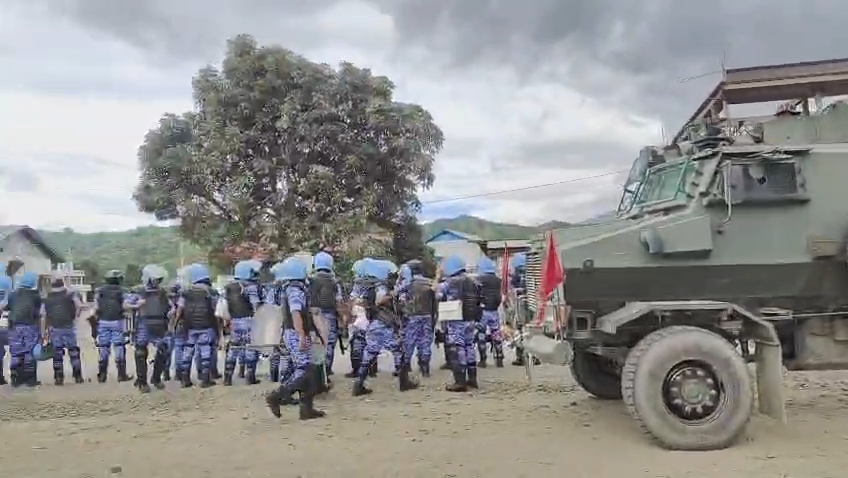
In a swift response, security forces, including Police, the CRPF and RAF, launched a major operation at Keithelmanbi Military Colony on Wednesday morning in connection with the incident.
The operation, however, sparked a brief confrontation after Kuki-Zo women accused the security forces of conducting “forceful and selective” action against their community.
The women questioned why an equally prompt security response was not mounted after Kailenjang village was attacked on August 10, when several houses, including the residence of the village chief, were reduced to ashes.
“If this is not selective action, then what is it?” the women asked, questioning what they described as a stark disparity in the security response to attacks on the two communities.
The alleged disparity also triggered a brief shutdown in Kangpokpi town, with business establishments downing shutters in protest against the security operation at Keithelmanbi Military Colony.
The Committee on Tribal Unity (CoTU), Sadar Hills, meanwhile, condemned the alleged razing of the abandoned Tokpa Naga village but strongly criticised what it called the “swift but partisan” response of the security forces.
The CoTU said the security forces had acted swiftly over the Tokpa Naga incident but remained “mute spectators” following the alleged razing of Kailenjang village, demanding equal and impartial action in both cases.
The committee also alleged that Kailenjang was attacked on August 10 by cadres of the NSCN-IM and its alleged proxy militia, the ZUF (Kamson), and questioned the timing of the incident, which coincided with a state government delegation’s talks with the United Naga Council (UNC) at Senapati.
The delegation was led by Deputy Chief Minister Losii Dikho and Home Minister Govindas Konthoujam and included several valley legislators.
The CoTU alleged that the UNC’s demands, including abrogation of the Suspension of Operations agreement between Kuki armed groups and the Centre and removal of Kuki-Zo-appointed Deputy Chief Minister Nemcha Kipgen, as conditions for lifting its inter-district blockade, represented a “political discourse” aimed at exerting pressure on the state government rather than seeking justice.
The committee urged the Centre and the Manipur government to abandon what it described as a policy of selective operations or “appeasement” and ensure equal justice for victims of violence.
It alleged that three church leaders and 13 Kuki-Zo civilians had been killed and nearly 20 Kuki-Zo villages had been razed or uprooted since May 13, 2026, allegedly by the NSCN-IM and ZUF (Kamson).
The CoTU warned that selective enforcement could further erode public confidence in the state’s security and governance mechanisms.
The latest incidents have added another volatile layer to the already fragile security situation in Kangpokpi, where competing allegations of attacks, selective enforcement and partisan security action have continued to fuel mistrust between communities.