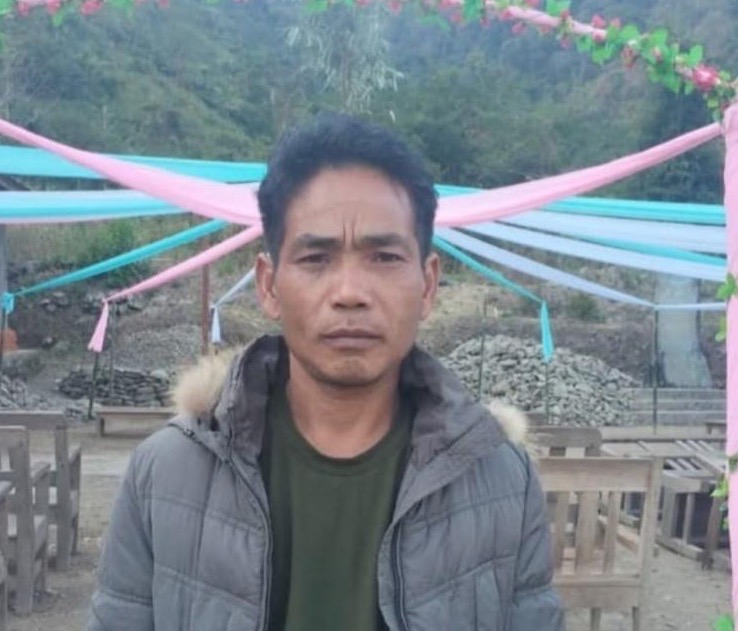
The killing of 45-year-old farmer Haokhogin Lhouvum of Lasan village in Tamenglong district has triggered a storm of outrage across the Kuki-Zo community, with major civil society organisations, church leaders, human rights groups and student bodies condemning the incident as a "cold-blooded murder" and demanding immediate accountability, enhanced security protection and an independent probe into what they describe as a growing pattern of targeted attacks against Kuki-Zo civilians.
The condemnation came after Lhouvum was shot dead while working in a paddy field near Lasan village along the IT Road on June 9. The incident occurred on the very day that 14 Kuki-Zo hostages, who had spent nearly a month in captivity, were released, raising fresh fears that emerging efforts toward peace and reconciliation could once again be derailed by violence.
Leading the chorus of condemnation was the Kuki Inpi Manipur (KIM), the apex body of the Kuki tribes, describing the killing as a stark reflection of what it called the grave failure of the state's security apparatus and persistent administrative indifference towards Kuki-Zo villages.
The organisation questioned why vulnerable Kuki habitations in Tamenglong district continue to remain exposed despite repeated appeals for security protection. It further alleged that Kuki-Zo villages were not receiving the same level of security attention afforded elsewhere.
KIM said the killing raised serious concerns about the effectiveness of existing security arrangements and questioned why innocent Kuki villagers continued to become victims of violence despite the presence of security forces in the region.
The organisation also expressed concern over what it described as a recurring pattern of attacks directed against Kuki-Zo civilians, warning that such incidents were deepening divisions, undermining prospects for peace and eroding trust between neighbouring communities.
"The repeated failure of the authorities to ensure the safety and security of the Kuki-Zo people cannot be tolerated indefinitely," the statement said, adding that the restraint and cooperation shown by the Kuki-Zo community should not be mistaken for weakness.
The Kuki Organisation for Human Rights Trust (KOHUR), described the killing as a "cold-blooded" and "senseless" act carried out against an unarmed civilian pursuing his livelihood.
The human rights body alleged that Lhouvum was killed by armed cadres of NSCN-IM and the Zeliangrong United Front (ZUF/ZUF-K) while on his way to his farm. The organisation described the deceased as an ordinary, peace-loving family man whose life was abruptly cut short, leaving behind a grieving wife and young son.
KOHUR argued that the killing was not an isolated incident but part of what it termed a continuing campaign of targeted violence against Kuki-Zo civilians and villages in the hill districts of Manipur.
According to the organisation's documentation, at least eleven Kuki-Zo civilians have been killed since March this year in a series of attacks across Ukhrul, Kangpokpi and Tamenglong districts. The victims include church leaders and pastors who were reportedly engaged in peace and reconciliation efforts.
KOHUR further cited a series of attacks and arson incidents allegedly targeting Kuki-Zo villages, including Gamphal and Haijang in Kamjong district, Lanchah village in Kamjong, and Loibol Khullen in Kangpokpi district, where houses and vehicles were reportedly burnt.
Describing the attacks as acts of terror rather than acts of war, the human rights organisation asserted that the deliberate targeting of non-combatant civilians and the destruction of villages constituted serious violations of human rights and humanitarian principles.
Expressing concern that no perpetrator had been arrested or prosecuted in connection with any of the reported incidents, KOHUR demanded an immediate, independent and time-bound investigation, preferably by the National Investigation Agency (NIA), into the killing of Haokhogin Lhouvum and all other documented attacks.
It also called for adequate security deployment in vulnerable villages, compensation and rehabilitation for affected families, and urgent intervention by the Government of India, the Government of Manipur and the National Human Rights Commission.
The Kuki Christian Leaders' Forum (KCLF) echoed similar concerns, saying the killing had cast a dark shadow over what should have been a day of relief and celebration following the release of the 14 Kuki-Zo hostages.
While expressing gratitude over the safe return of the captives, the forum said it was deeply saddened by the killing of an innocent civilian who was peacefully engaged in agricultural work.
The forum warned that such violence risked undermining the progress achieved through recent reconciliation initiatives and could once again fuel fear, uncertainty and mistrust among communities.
Calling upon all communities to continue striving for peace, healing and restoration, KCLF appealed to church leaders at regional and national levels to actively engage in efforts aimed at finding a permanent solution to the ongoing conflict in Manipur's hill areas. The forum urged people to reject violence and instead work toward building mutual trust, dignity and harmonious coexistence.
The Kuki Inpi Sadar Hills (KISH) expressed alarm over reports that the team transporting the mortal remains of Haokhogin Lhouvum was allegedly denied passage through Makui village while returning to Kangpokpi.
According to KISH, the reported obstruction forced the body recovery team to undertake a difficult alternative route before eventually reaching Kangpokpi with the deceased's remains.
Describing the incident as a serious humanitarian concern, KISH said respect for the dead and compassion for grieving families should never become casualties of political disputes, ethnic tensions or armed conflict.
The organisation pointed out that the Kuki-Zo community had consistently upheld humanitarian principles even during periods of heightened conflict and cited instances where the mortal remains of individuals from other communities were allowed safe and unhindered passage through Kuki areas.
The treatment allegedly meted out to the body recovery team, KISH said, stood in stark contrast to those principles and warranted clarification from the concerned authorities and community leaders.
Meanwhile, the Kuki Students' Organisation (KSO) Twilang Block strongly condemned the attack, describing it as a cowardly and unforgivable act against a peaceful farmer engaged in his daily livelihood.
The student body said that the killing of Lasan farmer Haokhogin Lhouvum occurred barely a day after the State Director General of Police (DGP) visited Kangpokpi district to assess the prevailing law-and-order situation and review measures aimed at strengthening security in vulnerable areas, raising serious questions about the effectiveness of the government's security apparatus.
Seizing on the timing of the attack, the KSO Twilang Block described it as a "premeditated strike" carried out in the immediate aftermath of the DGP's visit, arguing that the incident exposed glaring security lapses despite the highest-level assurances of vigilance and protection.
The organisation asserted that the brazen daylight killing of an unarmed farmer in a sensitive and vulnerable area underscored the complete failure of the state machinery to deter armed violence and safeguard innocent civilians. It maintained that such attacks, occurring even after a high-profile security review by the state's top police officer, reflected a troubling collapse of law and order, emboldened perpetrators, and reinforced fears among residents that vulnerable Kuki-Zo villages continue to remain exposed despite repeated promises of enhanced security and protection.
KSO maintained that the Kuki community residing in Twilang Area and along the IT Road had consistently upheld peaceful coexistence with neighbouring communities and warned that attacks on innocent civilians only served to challenge communal harmony and provoke instability.
Calling upon the Kuki community to remain united and vigilant, the organisation urged people not to be swayed by misinformation and to stand firm in protecting their villages and communities.
The organisations unanimously demanded justice for the slain farmer, equal protection under the law for all communities, accountability for recurring security failures, and urgent intervention to prevent further bloodshed in Manipur's conflict-hit hill districts.