
Is "Nagaland for Christ" a Missionary Mandate or Ethno-Religious Supremacy?
This logic of divine cartography is structurally identical across global majoritarian movements.
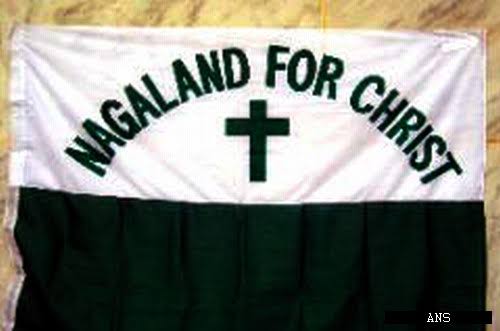
When political movements wrap territorial ambitions in sacred scripture, they transform worldly geopolitical rivalries into divinely sanctioned mandates. In Northeast India, the slogan “Nagaland for Christ” has long been projected as an innocent declaration of global missionary purpose—a narrative of a devout people seeking to spread the Gospel across international borders. However, a critical interrogation of this ideological apparatus reveals a far more troubling reality. Rather than functioning as a theology of universal liberation or Christian reconciliation, “Nagaland for Christ” operates as a majoritarian, ethno-theocratic ideology. In its structural mechanics, it directly mirrors Hindutva, Right-Wing Zionism, and American Christian Nationalism, relying on the exact same hazardous logic: divine cartography, demographic anxiety, the creation of an existential internal enemy, and the moral absolution of violence against neighboring minority populations.
In his landmark study, Evangelising the Nation: Religion and the Formation of Naga Political Identity, historian John Thomas historicizes how an individualized, fundamentalist variety of American Evangelical Christianity came to mediate the Naga political self. Brought by colonial-era missionaries, this theological framework focused heavily on individual salvation, personal piety, and strict moral codes, while remaining aggressively exclusive toward other faiths and blind to structural political realities. Over time, this theology imposed a religious prerequisite on national identity, wherein being an Evangelical Christian increasingly became essential to being a “legitimate Naga”. Building on this critique, scholar Arkotong Longkumer, in Bible, Guns and Land: Sovereignty and Nationalism Amongst the Nagas of India, demonstrates how "Nagaland for Christ" acts as a covenant where national territory is not merely a fixed geographic unit, but a performative act of religious imagination. Longkumer notes that in the nationalist narrative, territorial independence and transforming Nagaland into a mission hub to evangelize the world are treated as two sides of the same coin.
While first adopted as "Nagaland for Christ" during the early national movement in 1956, the slogan was later reframed by Thuingaleng Muivah and the Nationalist Socialist Council of Nagalim (NSCN-IM) into "Nagalim for Christ." This subtle shift in nomenclature was deeply consequential: "Nagalim" expanded the territorial scope from recognized state boundaries to a "Greater Nagaland" encompassing overlapping hill districts in Manipur and beyond. Under Muivah’s formulation, "Nagalim for Christ" ceased to be merely a spiritual motto and became a doctrine of divine cartography. This conceptualization is vividly captured in an interview between anthropologist Abraham Lotha and Thuingaleng Muivah, the top leader, principal ideologue, and Ato Kilonser (Prime Minister) of the NSCN-IM. Muivah argues that because God created heaven and earth, God explicitly allocated a specific land to the Nagas, asserting that that portion particularly is the Patkoi range because they were made to settle down there, making Nagaland a most precious homeland given by divine will. Explaining that land and “Nagaland for Christ” are central to his concept of sovereignty, Muivah asserts that because Christ died for the Nagas and Nagaland, their national identity and territorial borders are ordained by God, demarcated in the same cosmic manner that God separated light from darkness. When Muivah insists that Nagaland was not created by Indians, nor by the British, nor by the Naga people themselves, but by a divine Creator, he performs a radical act of divine cartography.
This rhetorical maneuver finds a striking, near-identical parallel in Donald Trump’s political discourse and the broader American Christian Nationalist movement. Trumpist rhetoric frequently invokes biblical passages, such as Acts 17:26, which states that God determined the allotted boundaries of nations, to argue that national borders, territorial sovereignty, and strict exclusion are divinely instituted rather than humanly negotiated. In both frameworks, the nation-state is removed from the realm of secular history, human diplomacy, or constitutional compromise. By claiming that borders were drawn directly by the Creator, both Muivah and Trump construct a political theology wherein any territorial concession, power-sharing arrangement, or demographic integration is framed not as a political compromise, but as a betrayal of God's divine order.
This logic of divine cartography is structurally identical across global majoritarian movements. Hindutva frames India (Bharat) as an inherently sacred land (Punyabhumi) belonging exclusively to those whose ancestral and holy sites lie within its borders, defining religious minorities as alien threats to the civilizational core. Right-Wing Zionism invokes biblical covenants to assert exclusive national rights over Greater Israel, viewing non-Jewish indigenous populations as demographic obstacles to an ethno-religious mandate. Trumpism leverages Christian Nationalism to claim America as a uniquely chosen nation under divine blessing, framing borders and demographic shifts through an apocalyptic battle between godly order and foreign subversion. In every case, including Naga ethno-nationalism, a divine or ancestral mandate combines with demographic fear and a myth of victimhood to yield ethno-nationalist dominance.
The immediate consequence of claiming a divine territorial monopoly is the creation of an existential internal enemy. If a piece of land is sacralized as an exclusive inheritance, any neighboring community sharing those hills is no longer seen as a fellow neighbor, but as an encroacher violating a divine plan. As Longkumer observes, this territoriality relies heavily on constructing an 'Other'—a mechanism that provides the ideological justification for structural violence and ethnic cleansing. The devastating toll of this exclusivist ideology is recorded in the modern history of Northeast India. During the 1990s, campaigns to consolidate territory for a unified Greater Nagalim resulted in brutal ethnic violence against the Kuki-Zo people. Over 1,000 Kuki civilians were killed in targeted massacres, more than 350 villages were uprooted and burned, and over 100,000 people were displaced from their ancestral lands.
Far from being a closed chapter of history, this radicalization continues into the present day. In the ongoing turmoil across Manipur and the surrounding hill areas, armed factions continue to leverage this exclusivist posture. The weaponization of economic blockades along vital lifelines, the dissemination of propaganda painting minority populations as foreign illegal immigrants, and targeted atrocities—including the May 2026 ambush in Kangpokpi district that claimed the lives of Reverend Dr. Vumthang Sitlhou, Reverend Kaigoulun Lhouvum, and Pastor Paogoulen Sitlhou as they returned from an inter-church peace assembly—demonstrate how ethno-nationalist arrogance operates on the ground. Herein lies the moral paradox of "Nagaland for Christ." How can a movement that claims to carry the name of Christ execute blockades, land-grabbing, and the murder of fellow Christian leaders returning from peace delegations?
The answer lies in the specific nature of the imported evangelicalism critiqued by Thomas and Longkumer. Because this theology reduces faith to personal morality while ignoring structural justice and neighborly love, its adherents can maintain a sense of internal spiritual purity while harboring intense ethnic chauvinism. The slogan becomes a moral shield—a mask that allows cadres to view themselves as soldiers of God while committing acts that violate the core tenets of Christian ethics. To dismantle this toxic majoritarianism, faith in the region must be deconstructed and liberated from Western imperialist frameworks that weaponized religious identity to create rigid communal divisions.
A genuine Christian theology cannot coexist with ethnic supremacy. True faith demands the rejection of divine entitlement, the public confession of past atrocities, and an adherence to the radical command of loving one's neighbor as oneself. Until "Nagaland for Christ" is stripped of its ethno-theocratic arrogance and subjected to rigorous ethical critique, it will remain not a mission of peace, but an engine of division, violence, and subjugation.
(Views expressed are personal)



The Hills Journal
K. Salbung, Churachandpur
Manipur-795128