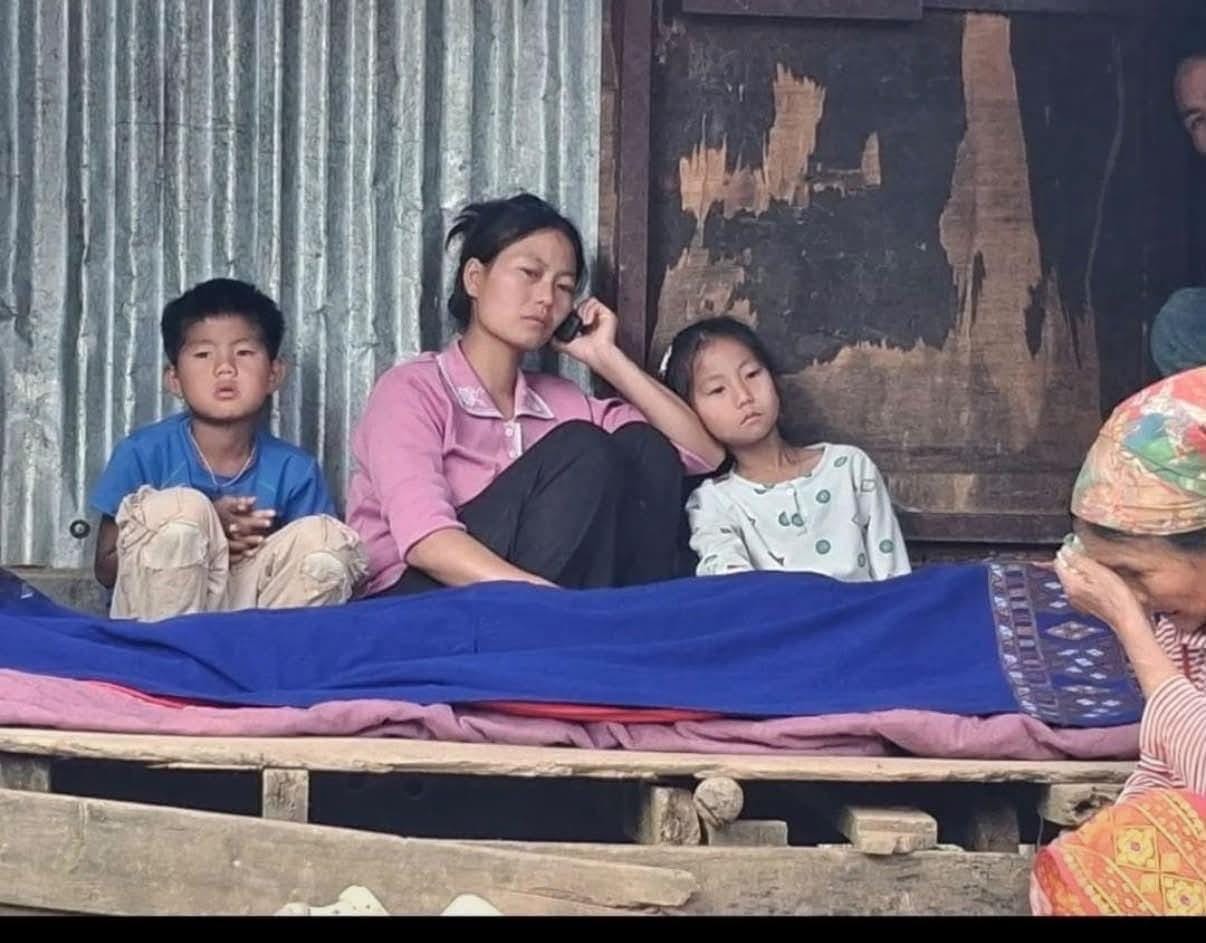
In a heartbreaking reflection of the deepening security crisis in Manipur’s Kamjong district, the body of a 35-year-old Chassad villager, Seikhohao Haokip, who was shot dead on October 17 afternoon, lay unattended through the night amid relentless gunfire and heightened tension before it could be recovered on Sunday morning.
A father of three young children, Haokip remained where he fell, in a pool of blood, as his family and fellow villagers were unable to retrieve his body through the night because of the volatile situation and continuous firing, according to local accounts.
The grief-stricken family, joined by mourning villagers, received his body at his residence, where his wife, children and fellow residents mourned his death.
Haokip was allegedly killed after being struck by multiple bullets fired from the direction of Chassad Police Station on Saturday, when villagers and local leaders were reportedly engaged in repairing electricity lines to restore power to the village. The incident also left several village leaders and Village Authority members injured.
In a significant administrative development amid the mounting security concerns, the Manipur government on Sunday issued a transfer and posting order through the Department of Personnel and Administrative Reforms (Personnel Division), replacing Tholu Rocky, MPS, who was in charge of Superintendent of Police, Kamjong, with Jay Barange, IPS, as the district’s new SP.
The change comes as Chassad and neighbouring areas face heightened tensions following a series of deadly incidents, including the killing of civilians and fresh attacks on the village.
For Haokip’s wife and three children, however, the administrative change offers no immediate relief from the irreparable loss of a husband and father. Their family home has become a place of mourning, as they confront a future without the man whose life was cut short in the violence.
Manipur Deputy Chief Minister Nemcha Kipgen strongly condemned the deadly attack on Chassad village in Kamjong district, describing the violence as an “intolerable crime” and calling for the perpetrators to be swiftly brought to justice.
Kipgen said the attack claimed the life of Chassad villager Seikhohao Haokip, critically injured village chief Thangjahao Haokip and several Village Authority members, and left homes burned down, while peaceful villagers were terrorised and families forced to flee.
“Terrorising peaceful villagers and driving families with young children out into the dead of night is utterly unconscionable,” she said, extending her heartfelt condolences to the bereaved family and praying for the speedy recovery of the injured village leaders.
Expressing deep concern over the plight of traumatised and displaced families, the deputy chief minister said targeting civilians and burning homes struck directly at the foundations of grassroots peace.
Kipgen said she had instructed the district administration, state police and security forces to maintain round-the-clock vigilance on the ground, protect civilian lives and property, and ensure that those responsible for the attack were brought to justice without delay.
Appealing for restraint amid the volatile situation, she urged community leaders, civil society organisations and citizens to reject rumours and refrain from actions that could further aggravate tensions.
“Safeguarding peace, law, and human life must remain our shared commitment,” she said.
Meanwhile, the Chassad Village Authority in has accused local authorities of failing to protect civilians amid a series of killings and armed attacks since October 9, demanding immediate deployment of central forces, an independent probe into the incidents and accountability for alleged administrative lapses.
The authority said repeated violence, the alleged lack of effective preventive measures and concerns over the impartiality of local security personnel had severely eroded public confidence in the district administration.
It appealed to the Centre, the Union Home Ministry, the Manipur government and senior security authorities to intervene directly, deploy adequate Central Reserve Police Force (CRPF) and Assam Rifles personnel, and ensure impartial security arrangements to prevent further loss of life.
The authority cited a series of deadly incidents since October 9, including the reported killing of Domkhonei Touthang and Michael Ngamminlen Haokip in an incident allegedly involving Indian Reserve Battalion (IRB) and police personnel.
It also referred to the October 15 killing of Hatneikim Haokip of Molvailup village in an alleged ambush by NSCN(IM) cadres along the Phaikoh-Molvailup road, alleging that the security response had failed to adequately address the threat to civilians travelling through the area.
In the latest incident, Seikhohao Haokip was killed and five others injured when firing reportedly broke out on October 17 as Chassad village leaders and residents were repairing electricity lines to restore power to the village, the authority said.
It alleged that the firing originated from the direction of Kamjong Police Station, where security personnel, including Border Security Force (BSF) personnel, were reportedly present.
The authority said reports that an IRB personnel and a police personnel had approached the electricity-repair team shortly before the firing and subsequently left the location warranted urgent and impartial investigation.
It also flagged allegations of possible coordination involving SNA, NSCN(IM), its Eastern Flank, Khanuithot and certain IRB and police personnel in connection with the incidents, calling for a thorough investigation into any suspected collusion or misconduct.
Rejecting allegations that Kuki National Army-B (KNA-B) was responsible for burning Chassad village, the authority termed the accusations false, misleading and unsupported by credible evidence.
Among its key demands are the immediate deployment of sufficient CRPF personnel in and around the village, the deployment of Assam Rifles, and a review of the existing local security arrangements. It also sought the withdrawal or reassignment, where justified by credible evidence, of police personnel stationed at Kamjong Police Station whose conduct or impartiality has been questioned.
The authority demanded a time-bound, independent investigation into all incidents since October 9, including the three reported killings, the October 17 firing and allegations of collusion involving security personnel.
Expressing a loss of faith in the Kamjong district authorities, the village body alleged a pattern of favouritism towards the opposing community at the expense of Chassad residents’ safety and security. It said the existing district-level arrangements could no longer be relied upon alone to guarantee the protection of life and property.
“The protection of life and property must never be determined by ethnic identity, community affiliation or political influence,” the authority said, calling for the rule of law to prevail without fear, favour or discrimination.
It said the people of Chassad village wanted justice for the deceased, accountability for the violence and immediate, impartial security measures to prevent further civilian casualties.
Meanwhile, the Kuki CSO Working Committee (WCKCSOs), Ukhrul, has raised serious questions over the integrity of Chassad Police Station, the conduct of local MLA Leishiyo Keishing and possible political or institutional complicity in a series of deadly attacks on Kuki-Zo civilians in Manipur’s Ukhrul and Kamjong districts, demanding an independent probe and immediate deployment of neutral central security forces.
The committee alleged that repeated killings, the reported firing on civilians from a bunker inside Chassad Police Station and subsequent arson attacks pointed to a grave breakdown of security and accountability, calling on the governments of Manipur and India to explain how civilians continued to face deadly violence despite the presence of security establishments.
The committee also announced a total shutdown of National Highway 202 from midnight on October 18 to midnight on October 22 in protest against the killings, the circumstances surrounding the Chassad firing and what it described as the absence of credible security arrangements. It warned of intensified agitation if its demands were not met.
Recalling the series of killings since October 9, the committee questioned the conduct of Leishiyo, alleging that the MLA visited Chassad on the same day but declined to meet the victims. It also raised concerns that security arrangements for his visit may have diverted resources from other vulnerable locations, asking whether the deployment left other areas exposed.
It further called for scrutiny of a letter issued by Leishiyo on October 10 seeking the deployment of state security forces, and demanded an impartial examination of the request, the allocation of security resources and whether political decisions contributed to the vulnerability of Kuki-Zo civilians.
The committee's strongest allegations concerned the October 17 firing at Chassad, in which Seikhohao Haokip, son of Thangkhochon Haokip, was killed and four other Kuki-Zo men were injured while repairing electricity lines about 60 metres from Chassad Police Station.
According to the account cited by the committee, a police constable and an Indian Reserve Battalion (IRB) personnel questioned the five men about their activities. After being told they were repairing electricity lines, the two personnel reportedly returned to the police station, following which gunfire erupted from a bunker, catching the men off guard.
The WCKCSOs demanded an independent investigation to establish who opened fire, whether any orders were issued and whether criminal, supervisory or command responsibility was involved.
It also expressed alarm over reports of NSCN(IM) presence and movements around Chassad Police Station and the wider region, questioning whether the station had been compromised and whether armed groups were operating nearby without effective intervention.
The committee said authorities must explain how civilians working in close proximity to the police station could come under fire if the premises remained under lawful state control. It stressed that allegations of militant presence, collusion, command failure or political interference must be investigated rather than presumed, with evidence examined independently and without political influence.
The firing was followed by renewed attacks on Chassad, with the committee alleging that more than 30 houses were burned and residents were forced to seek shelter within the village.
It said Chassad also serves as a grouping centre for internally displaced Kuki-Zo families from Kamjong district, including people who fled alleged NSCN(IM) intimidation or the burning of their villages. Having already lost their homes and security, these families now depend on village volunteers for protection, it added, warning that any weakening of Chassad's defences would further endanger an already traumatised population.
The WCKCSOs placed four key demands before the authorities: immediate withdrawal of the existing state security personnel from Chassad Police Station and deployment of a neutral central force, preferably the Assam Rifles; investigation into the alleged presence of NSCN(IM) around the station and whether it had been compromised; an independent probe into the bunker firing, the Phaikoh-Molvailup ambush and the MLA's conduct, including the October 10 letter; and a determination of whether security failures, collusion or orders from within the state machinery contributed to the attacks.
The committee said it was not pronouncing anyone guilty without an investigation but insisted that the allegations be examined without political interference, selective accountability or institutional cover-up.
It demanded that every person found responsible be held accountable, irrespective of rank or office, and warned that assurances without accountability would be an insult to the victims.
“When civilians are killed, armed groups are alleged to operate unchecked, and bullets reportedly come from within a police station, silence is not an answer — and authority is not immunity,” the committee said.