
The Lost Generation: Inside the Broken Futures of Manipur’s Kuki-Zo Youth
For these students, a separate administrative unit is the only realistic path to restoring local universities and securing a future safe from valley-centric blockades.
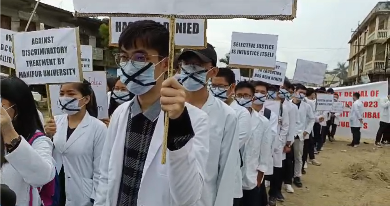
While political debates in Imphal and New Delhi circle around territorial integrity and central rehabilitation funds, an invisible crisis is gripping the youth of Manipur's hill districts. More than three years after ethnic violence fractured the state, Kuki-Zo students remain trapped in an agonizing academic and professional limbo. Their colleges are inaccessible, their career trajectories are shattered, and their aspirations remain frozen behind militarized buffer zones.

The Exile from Higher Education
Before the May 2023 crisis, the Imphal Valley was the state’s sole academic hub, housing premier institutions like Manipur University and the Regional Institute of Medical Sciences (RIMS).
Overnight, hundreds of Kuki-Zo students became academic exiles. Three years later, physical segregation remains absolute.
While the state government permitted ad-hoc measures like online classes and temporary examination centers in the hills, the compromise has diluted the quality of their education.
Medical and engineering students cannot gain vital clinical exposure or laboratory practice through phone screens, rendering them highly uncompetitive in the national job market.
Delhi’s Street Fury vs. The Hills' Silent Gridlock
The deep alienation felt by Manipur’s hill students stands in stark contrast to mainstream national youth activism. Recently, during the opening week of Parliament's Monsoon Session, New Delhi erupted into massive protests led by the youth-driven Cockroach Janta Party (CJP).
Thousands of students converged at Jantar Mantar for the "Chalo Sansad" march to demand accountability over national exam paper leaks, clashing with police and causing temporary mobile internet shutdowns in Central Delhi.
This high-profile movement highlights a bitter paradox. Mainland Indian students possess the political and geographical capital to take grievances directly to the gates of Parliament.
In contrast, displaced Kuki-Zo students in Churachandpur are denied the basic digital and physical infrastructure to even participate in the academic system. For hill youth, internet blackouts are not temporary, one-day security measures to contain a march; they are a chronic administrative hurdle that routinely blocks them from registering for national exams like NEET altogether. While the national consciousness focuses on reforming a flawed system, hill students are fighting a fundamental battle to prove they still belong to it.
Digital Disenfranchisement and Local Resilience
While students across India leverage remote internships and digital tools, Kuki-Zo youth battle erratic cellular networks and frequent, precautionary security internet shutdowns. This digital blockading severely restricts their ability to apply for competitive exams like UPSC or NEET.
Crucial registration windows open and close while hill districts remain disconnected, forcing students to undertake expensive, logistically hazardous travel to Mizoram or Assam just to download admit cards.
In response, student bodies and various youth-led collectives have stepped into the vacuum to establish makeshift libraries and volunteer-run coaching centers inside relief camps.
However, youth leaders emphasize that volunteerism cannot substitute for structural reform. The widespread youth support for a Separate Administration, specifically a Union Territory with a legislature under Article 239A of the Indian Constitution, is driven by survival rather than ideology. For these students, a separate administrative unit is the only realistic path to restoring local universities and securing a future safe from valley-centric blockades.
(Views expressed are personal)


The Hills Journal
K. Salbung, Churachandpur
Manipur-795128