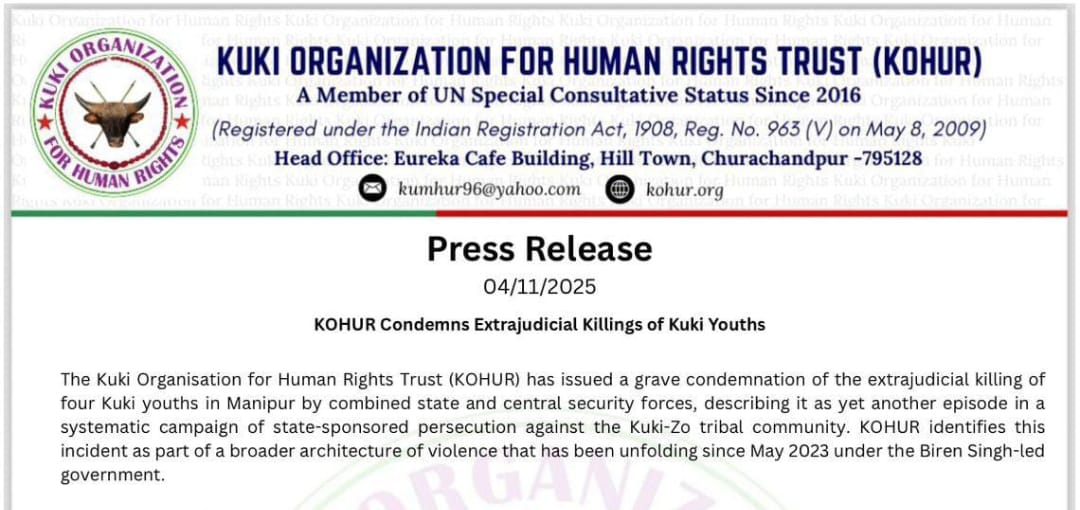
The Kuki Organisation for Human Rights Trust (KOHUR) has issued a scathing condemnation of what it describes as the extrajudicial killing of four Kuki youths in Manipur by combined state and central security forces — branding the incident as part of an “ongoing state-sponsored campaign of persecution” against the Kuki-Zo tribal community.
In its strongly worded statement, KOHUR asserted that the killings were carried out under fabricated circumstances by personnel of the 21 Para Special Forces and the Assam Rifles, following what it termed as a “staged encounter.” The Trust rejected the official justification that labelled the deceased as “terrorists,” describing it as a calculated attempt to vilify an entire community.
“This is not an isolated event,” KOHUR stated, “but a continuation of a genocidal campaign aimed at annihilating the Kuki-Zo people from their ancestral lands.”
The organisation further accused the Biren Singh-led Manipur Government of forfeiting its constitutional legitimacy by allegedly arming and abetting Meitei extremist militias, while simultaneously criminalising the Kuki-Zo community’s right to self-defence.
KOHUR’s documentation, the release stated, reveals entrenched patterns of militia-led violence, institutional impunity, and state complicity since the orchestrated attacks of May 3, 2023. The crisis, it added, is not merely an ethnic conflict but a “state-directed campaign of ethnic cleansing”— executed through the mobilisation of radical Meitei outfits such as Arambai Tenggol and Meitei Leepun.
The Trust alleged that the looting of over 6,000 automatic weapons and more than 500,000 rounds of ammunition from government armouries has empowered these militias to act as “state proxies”, operating freely across the Imphal Valley with impunity.
Despite these groups conducting daylight patrols, attacking police posts, and kidnapping officials, KOHUR noted that no credible government action or prosecution has followed, while Kuki-Zo village volunteers, who took up arms in self-defence, have been branded as “insurgents” and subjected to arrests and investigations.
Drawing parallels, KOHUR also referenced the killing of Hmar village volunteers in Jiribam, allegedly by central forces, which it said follows a recurring pattern of targeted, unlawful executions across Kuki-Zo areas. Despite media reports, no inquiry or accountability process has been initiated to date, leaving the victims’ families without justice or recognition.
KOHUR also condemned what it called the “discriminatory and selective” imposition of the Armed Forces (Special Powers) Act, 1958 (AFSPA) in Manipur — noting that 13 police stations in the Meitei-dominated Imphal Valley have been exempted from its purview, while tribal regions remain under the Act’s shadow.
According to KOHUR, this selective enforcement exposes a deliberate mechanism of suppression against the minority Kuki-Zo population, granting legal immunity to forces operating in tribal areas while shielding the majority-dominated regions.
“By lifting AFSPA from Meitei areas but retaining it in tribal regions, the state has effectively created two legal systems — one of privilege, and another of persecution,” KOHUR said.
The Trust maintained that this decision is “not administrative but ideological”, serving to legitimise militarisation and deepen inequality in the Kuki-Zo homeland.
KOHUR painted a grim picture of Manipur’s governance, asserting that over 60,000 Kuki-Zo civilians remain displaced, their homes destroyed and lands seized, while the state’s judicial, administrative, and security apparatuses have collapsed in upholding the rule of law.
The Trust alleged that ethnonationalist militias are now functioning as state auxiliaries, operating with total impunity and further entrenching communal divisions.
Given the scale of atrocities and the alleged complicity of state actors, KOHUR has called upon the United Nations and international human rights institutions to intervene immediately.
The organisation outlined the following demands:
- An independent international investigation into the extrajudicial killings of Kuki youths and Hmar volunteers, and all atrocities since May 2023.
- Accountability and sanctions against state and central officials responsible for human rights violations.
- Immediate dismantling of Meitei extremist militias and recovery of looted arms under neutral oversight.
- Deployment of international observers or a UN human rights monitoring mission to protect civilians and ensure adherence to India’s international obligations.
- Recognition and protection of the Kuki-Zo people’s rights to life, liberty, and self-governance through a secure administrative arrangement.
Reaffirming its commitment to peaceful advocacy and legal documentation, KOHUR warned that without urgent global intervention, Manipur risks descending into irreversible ethnic segregation and humanitarian catastrophe.
“Justice delayed is justice denied,” the Trust concluded. “Manipur’s crisis is no longer local — it is a test of India’s constitutional conscience and the world’s commitment to human rights.