Manipur has witnessed one of the most severe episodes of ethnic violence in its recent history. Since May 3, 2023, the state has been engulfed in a conflict that has disproportionately affected Kuki-Zo tribal communities, as they were ethnically cleansed from the majority Meitei community-dominated valley districts of the state. The inability of the N. Biren Singh's government to contain the violence — and, as alleged by critics, its complicity — ultimately led to the chief minister’s resignation and the imposition of President’s Rule on February 13, 2025, for an initial six months and later extended by another six months in August.
During this PR regime, the BJP leadership struggled to build consensus around a new leader acceptable to all the three major communities, Meiteis, Nagas and Kukis, to head the state government. As February 2026 approached, pressure mounted to restore an elected government before the one-year mark, which could have triggered legal complications. Despite strong opposition from Kuki-Zo groups, a new government was sworn in on February 4, 2026, with Yumnam Khemchand as chief minister. The new elected government secured the support of at least three of the ten Kuki-Zo MLAs, including BJP MLA and former minister Nemcha Kipgen who was made one of the two deputy chief ministers, one being Losii Dikho, a Naga leader from the Naga People’s Front. The other two were L.M. Khaute and Ngursanglur Sanate who are battling anti-defection proceedings after shifting allegiance from JD-U to the BJP soon after the 2022 election.
Within a few days of taking office, the new government faced its first major challenge as tensions erupted between the Kukis and Tangkhuls (Nagas) in Litan, Ukhrul district, on February 7, 2026. The conflict involved residents of Litan-Sareikhong — a predominantly Kuki village with a sizeable Tangkhul population — and neighbouring Sikibung, a Tangkhul village, following a minor altercation in which a villager from Sikibung sustained slight injuries. According to a statement issued by the Sareikhong Village Authority, family members of the injured individual approached the village chief, and both sides agreed to resolve the matter according to tribal customary laws the following day. This account was echoed by the Kuki Students’ Organisation (KSO), Ukhrul district unit.
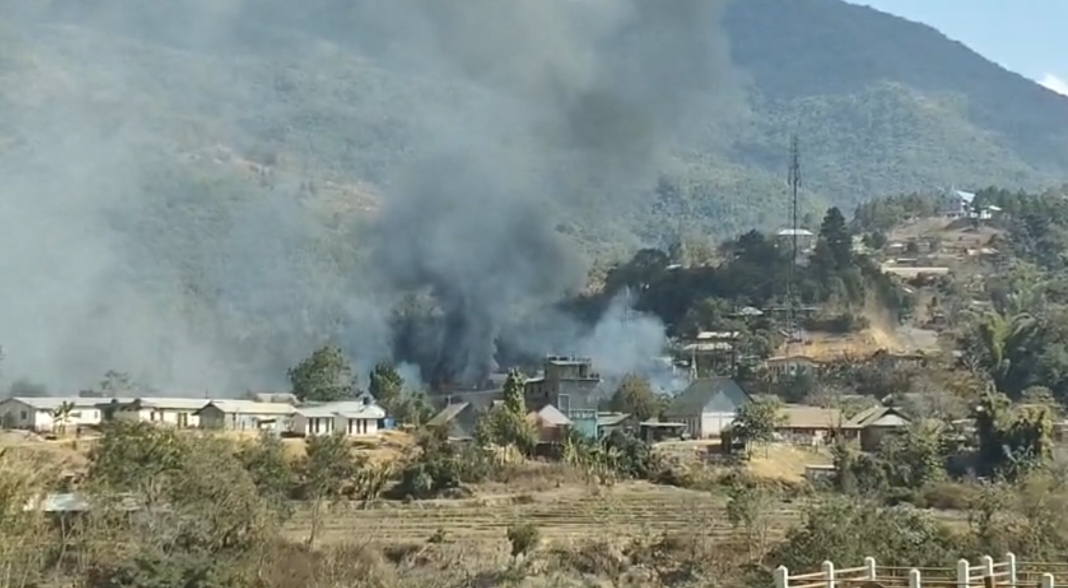
However, the situation escalated when a sizeable group from nearby Tangkhul villages stormed the residence of Sareikhong village chief, triggering a standoff between residents of the two villages. By evening, as tension between the two villages simmered, the Tangkhul mob bearing firearms burned down three houses belonging to Kukis, reportedly in the presence of personnel from Litan police station. Retaliatory attacks followed, resulting in the burning of about ten houses belonging to the Tangkhuls.
The following day, a meeting was convened between the MLAs of Phungyar and Saikul constituencies, civil society organisations from both communities, and deputy chief minister Losii Dikho, a prominent Naga leader. According to participants, the meeting failed to make any progress after representatives from the Tangkhul side left almost immediately after it began. Reports also indicated that houses in Litan-Sareikhong continued to burn even as the meeting was underway in the presence of the deputy chief minister at Litan police station.
With no immediate resolution in sight, curfew was enforced and security deployment tightened. Appeals for peace came from various quarters.
Meanwhile, Katho Tangkhul civil society organisations issued statements disputing that no agreement had been reached to resolve the initial dispute as the Sareikhong village authority and KSO-Ukhrul claimed. The NSCN-IM also issued a statement asserting territorial claims over Litan-Sareikhong and calling for evacuation of the village. Reports of continued arson targeting Kuki houses continued despite the presence of heavy security forces, including central forces.
It may be noted that Ukhrul district, where the incident occurred, has a Tangkhul majority population. Historical grievances and the absence of a comprehensive conflict-resolution process following past clashes has left many disputes unresolved. These tensions culminated into the Kuki-Naga conflict of the 1990s, during which hundreds of villages were destroyed and thousands displaced across the hill districts of Manipur and neighbouring states of Assam and Nagaland.
In March 2020, Chassad, a Kuki village in Kamjong district, previously part of Ukhrul district, was completely burned down following a dispute with neighbouring Tangkhul villagers on the issue of burning of jhum fields. Security forces, including Assam Rifles, posted in the area at the time were widely criticised for failing to intervene promptly. The NSCN-IM also issued a press statement two days later claiming that the incident “could have been avoided had the Kukis of Chassad village not taken law and order into their hands regarding the burning down of jhum cultivation fields blaming the Kamjong villagers.”
In remote hill areas where armed insurgent groups such as the NSCN-IM operate, civilians—particularly those from minority communities—are usually left at their mercy. Even law-enforcement agencies, including state and central forces, often remain mute spectators, for reasons best known to them, as the mobs are perceived to be backed by such armed groups.
Once again, amid heightened tensions in the Litan area, reports emerged of a Tangkhul mob approaching Chassad village with torches on the night of February 10, 2026, which compelled the innocent villagers to seek shelter at the nearby Assam Rifles camp, fearing a repeat of the 2020 incident. Later, it was reported that the mob was frisking vehicles of Assam Rifles as they suspected them to be transporting “Kuki militants.”
These incidents underscore the fragility of peace in Manipur. In a state deeply polarised along ethnic lines, even minor altercations, such as drunken brawl as in this case, can escalate into large-scale violence if not addressed swiftly. The timely and impartial intervention of law-enforcement agencies is crucial in preventing and containing such escalation. In the Litan-Sareikhong case, the newly installed government failed its first major task by not only preventing but also in containing the violence from further escalation and in restoring confidence among the affected communities even after three days of continued violence.
As tensions persist, many fear that without sustained political will, credible mediation, and firm enforcement of law and order, even isolated minor incidents will continue to risk spiralling into broader conflict. For now, the state must intervene immediately and decisively to ensure the Litan-Sareikhong incident does not spiral into a wider ethnic confrontation, as tensions continue to simmer even in the neighbouring areas.